Tuesday, September 8, 2026

A Trip Down Cyberpunk Lane

With the current iteration of The Ghost in the Shell (2026) streaming on Amazon, I'm reminded of the hours and days I spent watching as much cyberpunk anime as I could back in college. I owe the 2026 series a review once it's done. For now, I've republished a lot of my old blog posts related to the genre; hopefully, you'll forgive the musings of a young intellectual struggling to bridge pop culture and scholarship. At the very least, I'll seem like I know a thing or two about anime.

On a broader note, it's cool to see the internet discourse about a franchise I've loved for nearly two decades. Ghost in the Shell has seen many incarnations, and I've always believed in the relevance of its themes. The story is rooted in a what-if scenario for post-Cold War politics: nuclear weapons are a constant threat, America is seen as an unabashed empire, nanomachines seem to infiltrate all aspects of human life, and people aren't ready to manage their own primitive instincts in a world inundated with AI. 

In the real world, we're witnessing the nascent stages of AI development and proliferation Interestingly, none of the Ghost in the Shell adaptations depict humanity as existentially threatened by it; rather, the stories are always about human persistence as we brave the unknown. There are more than enough interviews, articles, fake news, and essays about whether AI will wipe us out or usher in world peace, so I really don't care to interject with my worthless two-cents. All I can do is look forward to seeing how the human race, and my toddler in particular, answer these existential challenges.   

Here is a link to my undergraduate thesis, which has aged better than I thought but still tastes like a cheap wine bottle from CVS. A lot of my old cyberpunk anime posts were done in service to this 2013 project, my personal homage to Ghost in the ShellEstablishing a Post-human Identity through Mamoru Oshii's Ghost in the Shell and Innocence Films

If essays aren't your thing, you can just read my older Anime Guardians posts below. Perhaps you'll see an anime you've never heard of:

Finally, I don't advertise this much, but I do write science fiction when I'm not blogging. I have a short story, "The Zoo," featured in an upcoming collection, Forged in FIYAH: Celebrating Ten Years of Black Speculative Fiction. Once upon a time, I was obsessed with separating my blogging and professional writing personas, but I probably haven't done my career any favors by doing so. Being an otaku is sometimes weird, but it certainly isn't a crime. If you'd like to support me--albeit indirectly--at least preorder the book and get a sense for how all this cyberpunk has rotted my mind. 

To all five of my loyal followers: thank you for humoring an old man who refuses to migrate to a modern blogging platform. 

Saturday, July 4, 2026

Genshin Impact: This Dad's Early Morning Solace When the Baby Won't Sleep


I've been playing Genshin Impact since 2020, just a couple of weeks after launch date. I remember seeing buzz about it on Twitter (before the platform became X), and so I downloaded it for PS4. Although I don't have a lot of time for it now, I still play on the occasional morning when I wake up at four o'clock because of the cats or the toddler yelling. The game is still one of my favorites.

I think Genshin does a good job of making gaming very accessible to the non-competitive player. Genshin has a beautifully designed world with multiple continents, countries, and landscapes. The musical score is orchestral and changes according to what region of the map you're in, even from village to village. According to Gemini (I’m sorry, guys), the Chinese words for my feelings are 恬淡 (tiándàn) and 境 (jìng), which I believe reflect the peace I feel forgoing daily pressures and competition in favor of quiet serenity and beauty. I spend most of my time in Genshin ignoring the main storyline to complete character quests and special events, especially the annual Lantern Rite. This put me forever behind on current online discourse, but the art of "not caring" does wonders for making this game evergreen. 

I remember playing the original Animal Crossing on the Nintendo Gamecube (because I'm that old). Walking around an open world, foraging, and maintaining a simple cabin feel like weekend plans for modern hipsters, but it's also something many people can't do in the nonstop rush for productivity inside our concrete jungles. Genshin transports me to wide European-style plains, Japanese-like mountain ranges, and Liyue's beautiful golden trees. All I need to learn is hilichurl combat and I could be a character in this world, too.

To be honest, I don't spend much time in the other nations of Fontaine, Natlan, or Nod-Krai. The combination of locale and missions don't excite me as much. Maybe the nostalgia of the first few locales is what I stick around for; the introduction of Varka made me excited to be in Monstadt again. There's a new town just beyond Stormterror's Lair that I'm exploring now, a little port that makes me miss the bop of Port Ormos' music in Sumeru. 

I haven't talked much about the characters yet, but I'm also nostalgic when it comes to my original Monstadt and Liyue crew. I don't have many characters from the other continents; the most prominent ones are Dehya and the almighty Raiden Shogun. I'm not a meta player by any means, so the imaginary bonds I forge with these characters--combined with some consideration for element pairings--are all that matters for my team composition. If there's one complaint I have about gacha games like this, it's that there's too much catering to character releases and new content instead of tending to the rich story that's already available for deeper mining. That's why I always return for Lantern Rite: I love Liyue, and learning more about its history is a treat...even if it's a convenient excuse for devs to make up more characters for purchase.

In summary, some nights I'm tired and I want to return to well-tread ground. Genshin Impact is charming in that way, especially when the screaming kid and cats don't give a shit about whether or not daddy needs to work in the morning.

Friday, January 30, 2026

January 2026 Anime Roundup

Now that I'm a full-time professor, the holidays and New Years season comes with a lot of free time. I have to prep for spring semester of course, but it's important to recover from grading last-minute assignments and final reports and such. I made sure to catch up on a lot of otaku media this January.

Fate/Strange Fake is finally releasing episodes after the teaser film released last year. Fate/Grand Order did something like this years ago, but the release schedule for that FGO spinoff is decidedly all over the place because Aniplex resumed with Absolute Demonic Front Babylonia and the Final Singularity, then the Camelot films. 

r/grandorder - New Key Visual for ‘Fate/strange Fake’

Strange Fake feels closer to the Apocrypha series with precisely how...strange it is. There's a grail war in what looks like Arizona or some other Southwestern region of the US, and the war is a front for an actual summoning that needed the first war as a catalyst? Vampires are also in this universe, a subject straight out of another Type-Moon vehicle, Tsukihime. Strange Fate is undoubtedly cool, so I'm along for the ride anyway. But is the plot easy to follow? Hell no.

There's also Jujutsu Kaisen Season 3. I'd love to stop watching this series, as it's terribly depressing, but I can't. The animation is too good to look away. Episode 3 of this season almost brought me to tears with unpalatable mounds of exposition. Episode 4, though? Sheesh, I had to watch it twice because it was so flashy. One of the coolest fighting episodes of anything I've ever watched. Apparently, JJK manga die-hards were upset about it in Japan because the content in Episode 4 wasn't treated with enough gravitas, but they're insane. Anime should tell stories in the best way anime can, full stop.

jujutsu kaisen s3 ep4 review

Now, I engaged with two dark fantasy shows recently, Clevatess and Sentenced to be a Hero. I watched the former in Spanish, so I relied a lot on visual cues for context and missed out on some plot nuances, but Clevatess wasn't as good as I'd hoped. When they introduced a protagonist who resembles Claire from Claymore, and the story took place on a darkened continent surrounded by monsters and divine beasts like Claymore... Even forgetting about Claymore for a second, Clevatess is a weird experience. 

Hero Alicia is immediately defanged by Clevatess, one of four beast kings that humanity is trying to overcome so they can expand their territory. She is turned into a corpse-slave that lives thanks to Clevatess' blessing, and helps the beast king look after the infant heir to a kingdom he absolutely wrecks in the first episode. The earlier violence yields to some misunderstandings about breastfeeding, so Clevatess goes to find someone (other than the non-lactating Alicia) to feed this baby, and then the team actually finds a slave who happens to be lactating... Look, some stories just exist to satisfy a creative itch, I suppose. Not mine, to be clear.

Sentenced to be a Hero, on the other hand, successfully mixes dark fantasy with pathos in a non-creepy way. In this story, "heroes" are ironically named because they commit terrible crimes and are brought into an infinite-reanimation cycle to serve the state; in other words, more anime slaves. Xylo is one such slave, but instead of managing a royal child and searching for tiddy-milk, he accidentally bonds with an ultra powerful goddess who sees the good inside of him. Said goddess is naturally in the vessel of a child, but it's not weird, I swear! The story reminds me of other long-term revenge plots like Tales of Berseria and, dare I say it? Nah, you already know the anime I'm thinking of.

stark frieren and fern in frieren beyond journey's end season 2 episode 2

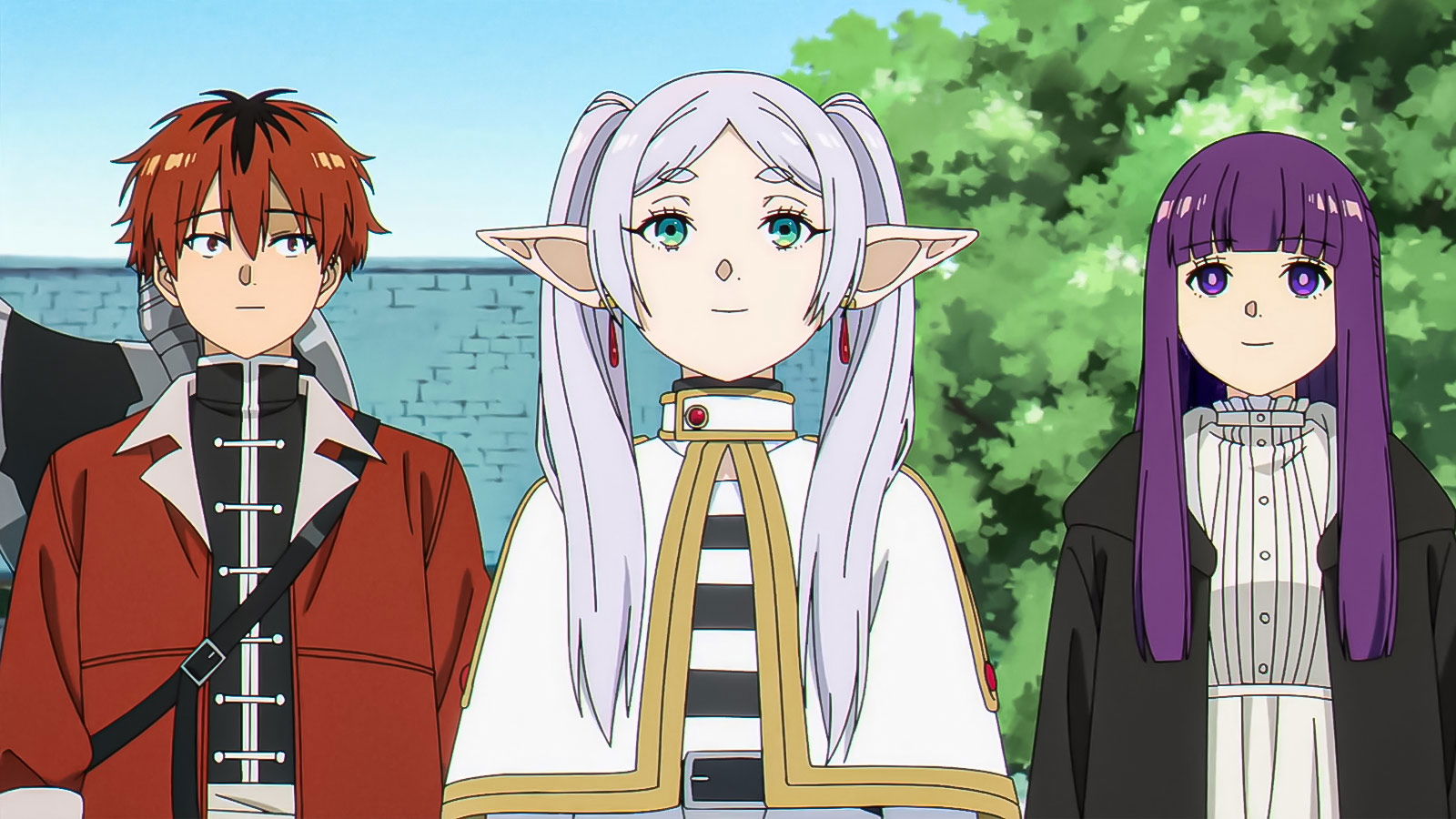
And then there's Frieren. Need I say more? If you liked the first season, you'll like the second season. I loved this story as it was released in manga (which is now in HIATUS, damnit), so the show manages to do it justice with more of that contemplative silence, serene countryside, sprawling fantasy music, and the occasional combat sequence. Just watch it, y'all. 

Know what I don't recommend? Tune into the Midnight Heart anime, which looks stiff at times and wonky at others. The manga's hilarious, so read that instead.

Friday, December 26, 2025

Chivalry of a Failed Blogger, or How Fictional Fighting High Schoolers Make Me Feel Young Again

I just learned that "gray" is the American English spelling of the color we all know, while "grey" is the spelling all those other former English colonies and territories use. Although I prefer the latter version, I'm obliged to use the former. Guess I'll stop drinking Earl Grey tea while I'm at it. 

Anyway, for a blog titled The Anime Guardians, I write a lot about anime-adjacent hobbies. Let's at least start out with an anime as I write about what I've been up to this fall/winter.

Chivalry of a Failed Knight – Anteiku Anime Reviews

Chivalry of a Failed Knight

Because I'm old, I remember seeing Chivalry of a Failed Knight floating on my Hulu home screen for ages and never watching it. Or did I watch it? The banner always reminds me of The Asterisk War, which I definitely tried to watch once but couldn't get into it. The premises seem kind of similar in any case; maybe pink-haired heroines and fighting schools were the craze in 2015. 

I watched (rewatched?) Failed Knight earlier this year when I was still a new dad and between power naps. It's good stuff! Protagonist Ikki Kurogane is the titular "failed knight" who, despite his superhuman swordsmanship, is considered bottom-of-the-barrel because his mana use isn't flashy or scary or something stupid like that. His family hates him save for a way-too-clingy younger sister who cockblocks the lad as he bumbles into a relationship with Stella Vermillion, the cool transfer student.

Where Does The Chivalry of a Failed Knight Anime End In The Light Novel?

Failed Knight keeps a lot of action at the forefront while making the romance genuinely worth the screen time. (I mean, there's some ecchi stuff cuz it's 2015.) Ikki is the over-analytical type, which  works for his perpetual underdog characterization. Think Dr. Stone's Senku or Death Note's L with sigma-male swag. Like any good fighting school anime, our cast ultimately competes to enter the Seven Stars Battle Festival, a tournament which has global repercussions not fully explained in the show. These details made me read the light novels to continue where the anime leaves off. If you're interested in reading after watching, volume 4 is where to start. I'm really digging volume 5 right now. 


Fate/Hollow Ataraxia Remastered

I recall ending the Switch version of Fate/Stay Night Remastered with a strong feeling of emptiness. Heaven's Feel route was a doozy! Do I think Shirou and Sakura belong together? I get the appeal, but if I were Shirou, loving the person who threatened to wipe out my entire town and to swallow her sister into eternal damnation wouldn't be my first choice. Anyway, I jumped into Hollow/Ataraxia because of a sunk-cost fallacy: why not continue feeling strangely empty and anxious if it means I find out what happens after the Holy Grail War?

The good news: There's a lot of wit and humor to the strange world our characters occupy. The servants are still around. Rider gets a lot of screen time for anyone who likes her; I've come around now that she's an enticing yet menacing recluse who reads all day. The other characters seem to grow jealous of this Shirou x Rider pairing. (This explains a lot of the fan art I've seen.)

The bad news: not enough Tohsaka. She's at the Mage Association abroad, but our central cast talks about her with apprehension, as if she'll appear and crush them with her oppressive attitude. 

I'm also haunted every time Ilya shows up onscreen. I liked her Heaven's Feel incarnation, but Hollow/Ataraxia keeps reminding me that she also wants to shackle Shirou's soul to a stuffed animal toy. I don't understand the brother-sister complex that shows up in otaku fiction. These people need to stop.

Alright, that's what I've got for the end of 2025. I get a month off from school to prepare for next semester, so maybe I'll rot on my couch and catch up on some anime instead. I should probably do some fiction writing as well. Happy holidays, everybody!


Sunday, August 10, 2025

The TCG You've Never Heard Of

Weiss Schwarz!!! It means "black and white" in German, but it's also the name of an esoteric trading card game from Japan. Featuring an assortment of anime, gaming, film, and other pop culture franchises, Weiss is the perfect game for otaku. After eight months of playing, I'm still learning new things and making a fool of myself at the local game shop. 

The end-game for Weiss is simple: do enough damage to your opponent to win. Unlike most TCG, Weiss doesn't have its own stable of characters, and there are no obvious deck-types or elemental advantages to consider. To balance this game, you really have to understand your own deck's character-based gimmicks to create an effective winning strategy. The Seven Deadly Sins anime has one of the lowest-priced trial decks, so that was my first Weiss purchase. I didn't do a good job of learning that deck's tricks; needless to say, I was thoroughly beaten for many weeks.

Is Weiss Schwarz fun? At first, hell no. I didn't win a game until I put together an entirely different deck: a Fate/Stay Night one based on character Rin Tohsaka. The deck is a little underpowered compared to others, but Rin's low attack damage is remedied by conditional buffs to beat tougher opponents. I won my first game with that Fate deck...before losing many more matches.

Rin Tohsaka: best girl in Fate franchise. 

Weiss isn't nearly as popular as Pokemon, Yu-Gi-Oh, or Magic the Gathering, so we're a small group at the back of the card shop on Sundays. When the Pokemon or Magic tournaments get too large, Weiss is cancelled for the day so there are more tables available. Because of the game's obscurity, it's difficult to obtain Weiss cards unless you preorder them early. On the other hand, there are no scalpers lurking around supermarkets and vending machines to buy all the stock at once, which has become a serious problem for Pokemon players. 

Why do I play? It's nice to be part of a community, no matter how small. It's nice to have new experiences. It's nice to get out of the house, play cards, and return home in time to eat dinner with my wife and kid. I think my record is 3-25 or something terrible like that; I picked up two of those wins during my last playthrough, so I've made progress! If I win another game before the end of the year, I'll be happy.

Tuesday, July 8, 2025

X-Men: The Manga and its No Good, Very Weird Government

I bought X-Men: The Manga Remastered the other day at Barnes & Noble. Narratively, it starts where the 90s animated series begins, on Jubilee as she runs from Sentinels that hunt an emergent mutant population. In order to end these discriminatory attacks, the X-Men make their way to a quasi-governmental facility that stores dossiers on mutants around the country. At first I thought, "Why would you have to go to a facility to do that? Can’t you just hack into their systems remotely?" Then it occurred to me: this story is set in the 90s. I’d almost forgotten what that world was like back then.

Paper documentation, especially at the government level, is a challenge I saw firsthand while working at a municipal court. My days were spent entering information, scanning, and filing it away for hours at a time. Need to issue a search warrant? Fax the judge. Need to collect payments? Send a certified letter. On the federal level, the government has tried to reduce paper processes: the Paperwork Reduction Act, the Paperwork Elimination Act, and several memoranda in recent decades (which points to the truism everyone knows by now: government is extremely slow to change). In the essay "The Filing Cabinet," Craig Robertson describes the archaic — and analog — filing process required for American federal workers to get paid, which can involve sifting through some 28,000 filing cabinets. Should everything be digitized nowadays? Can that be done? Who knows.

Here’s another weird example of inefficiency: SENTINELS. I didn’t think about how goofy these giant robot killing machines were growing up, but now I read X-Men and wonder, “How many are there? How much did the government pay these subcontractors to build them? What are the repair costs?”Considering there are no giant robots (we’re aware of) for commercial or military use, the only comparable product I’ve found is this $3,000,000 Tsubame Industries mech that resembles a really slow Armored Core. In a world where ICE raids are regularly conducted against illegal and migrant populations in the US, it’s obvious that a real government would spend big bucks to find perceived threats. Is this a good investment of our money? All I’ll say is the cost-benefit analysis of hunting mutants is clearly based in something other than a balanced budget. 

X-Men: The Animated Series. 1992. Marvel Entertainment Group.

Finally, the X-Jet is clearly an SR-71 Blackbird, an older stealth plane contracted by the government from Lockheed Martin. How this wound up in Charles Xavier’s hands depends on what version of the story we’re reading: he “obtained “ it from SHIELD, or Hank McCoy (aka Beast) built it, or it’s a modification of Xavier’s private jet. All scenarios imply massive security leaks pertaining to the design of a military stealth craft. As a telepath, Xavier could have easily wound up with the information needed to steal the plane or its schematics, but it also seems like a government fully aware enough to build giant robots for mutant hunting could also put more efforts into its security apparatus. 

Which brings us full circle to the X-Men raiding that facility for mutant records. The universe our heroes occupy may be full of hateful xenophobia, but luckily, the government gestapo is incredibly good at wasting time and money. 

Sunday, June 8, 2025

An Audience of One

Both of the manga I’m reading at the moment, Tune in to the Midnight Heart and Insomniacs After School, feature characters with personal broadcast radio stations via Internet streaming. I’m an avid streamer of podcasts, but that’s a slightly different flavor of online audio content that’s more curated and episodic than spontaneous. So, is this a thing Japanese high schoolers do? The short answer is, “I have no idea.” 

Tune in to the Midnight Heart. Masakuni Igarashi. Kodansha.

What’s interesting is that the protagonists in the aforementioned manga both maintain their closest relationships using streaming broadcasts to an audience of one person. If characters are confessing their feelings, it’s quite indirect when done through the radio. In my day, texting was the thing kids did; I guess radio is the new thing. I feel there’s a material difference in pretending you have an impersonal audience instead of just directly speaking to your friend. The question becomes, “Why do it this way?”

Modern dating is bad because men and women are doing a poor job of communicating or have nothing good to say. Many people blame the internet for creating information silos that breed stupid opinions and false facts, and this means men and women’s interior worlds are more easily exposed (and increasingly appalling to one another). Because much of our human interactions are mediated through text, I'd say that from a communications theory standpoint, the issue is this: sending texts is information-deficient when compared to radio — even an indirect broadcast conversation — because our voices carry messages through tone and volume, clarifying the intention of our speech. Text, as anyone who’s ever sent one can share, is notoriously hard to interpret even when intentions are good. It’s also easier to be an asshole when hiding behind your keyboard or firing off a quick message without thinking twice. I feel like using our voices is an extra level of personal investment and confidence that helps us be judicious with our words. (Unless you're Alex Jones, of course.)

Insomniacs After School. Makoto Ojiro. VIZ Media.

Radio broadcasts to my wife sound like a cute idea, but would quickly grow old because we already live with each other. For high schoolers who want to treat radio as a form of public journaling and indirect confessional, however, the practice seems harmless. If you don’t want your parents to see your call history, it’s certainly one way to avoid getting into trouble for talking late into the night. Ah, the beauty of being young…

Wednesday, May 14, 2025

Happy Blogiversary!

It’s been a year since the relaunch of this blog! Most of my anime consumption was a blur of late-night delirium while caring for my newborn. I haven’t been blogging as much as I hoped to, so I’ll share my current otaku consumption habits. Get ready for a super post!


CURRENTLY WATCHING: Witch Watch

Basically, each episode boils down to Nico the witch causing mayhem wherever she goes by casting magic spells to impress Moi, her childhood friend. I’m always looking for reasons to justify my OtakuUSA magazine subscription, so when I read about Witch Watch earlier this year, I had to tune in. The feature article promised a slapstick comedy, and the show doesn’t disappoint. My wife certainly likes the show (and she hates anime), so I know it’s good. Some of the jokes don’t land if you’re not super into Japanese media references; it’s just an excuse for me to do research in the future. Recommend.


CURRENTLY WATCHING: Anne Shirley

Remember that post I did on cozy anime? Anne Shirley is that kind of show. I remember my wife watching Anne with an E on Netflix, so she was excited to see this anime adaptation (which itself is a reboot of an older anime, which is ultimately based on a book I haven’t read). I think Anne is adorably melodramatic as a character, and I identify with her need to see wonder wherever she looks in the world. Life isn’t perfect but it is worth celebrating. Recommend.


CURRENTLY WATCHING: Ranma 1/2

Being familiar with Usurei Yatsura, I know that Rumiko Takashi’s style of rom-com is fun and cute. Ranma is enchanted by an ancient pool haunted by a drowned girl, and now he turns into a girl when touched by cold water. The hijinks, however, begin once his fiancee, Akane Tendo, learns about this alter-ego. I wondered about the sensitivity this story would bring to what is literally a transgender tale, but as with many good comedies, the ensuing absurdity and refrain from "punching-down" disarms a lot of potential discourse. Recommend.


CURRENTLY READING: Tune In To the Midnight Heart


I liked Quintessential Quintuplets; my wife was upset by the ending, and I understand why. If you were disappointed by Quints, I think Midnight Heart is for you. Taking the same playbook and adding ten times the humor, Yamabuki joins the Broadcast Club seeking a girl who he confessed to years ago; this girl is among the club's four female members. I can't overstate how much I like this manga. Every girl seems like she could be "the one," and although my favorite pairing is with Nene Himekawa, I don't feel there's a bad choice among them. Did I mention how funny this is? Recommend


CURRENTLY PLAYING: Tsukihime


After playing
Fate/Stay Night and all its routes, I thought another Type-Moon production would round out my understanding of this elaborate magical universe. Unfortunately, Tsukihime isn't my jam so far. The charm of Fate was an elaborately designed tournament with central characters who play well off each other and are also interesting themselves. Now, I wouldn't say Tsukihime has boring characters and a dull story...but it does. Fate's Shirou Emiya is compelling and complex in ways I've never seen, a character filled with a pathos that makes him frustrating and fascinating to follow. Maybe I'm impatient, but I'm not seeing that same appeal in this game yet. Can't recommend.

Alright, that's enough post for now. May's a super busy month so far, but I'd like to write more. Stay tuned!

Tuesday, January 21, 2025

What's Up with Anime Slavery? or The Rising of a Savior Complex

The Rising of the Shield Hero was the first time I recall encountering slavery as a topic in anime. The relationship between Naofumi, a reluctant and rejected hero without a party, and Raphtalia, a young tanuki-girl he buys to aid him in combat, blossoms into a beautiful bond. The fact that Raphtalia is a slave is somewhat corrected after Naofumi releases her from servitude, but then she volunteers to be enslaved anyway as a sign of her loyalty. It's sort of cute...but still slavery? As a result of encountering this institution in modern medieval, fantasy, and isekai genre shows, I thought to look up why people are writing this stuff nowadays.

The Rising of the Shield Hero. Kinema Citrus. 2019. 

My first instinct was to understand Japanese slavery precedents. Chris Kincaid offers a well-researched account in their 2021 article, "Slavery and Japan": A class system allowed for the legal selling of Japanese until the 12th century, when it was no longer a state-sponsored institution. Legitimized slavery briefly made a comeback after the Portuguese and Jesuits wanted women to take abroad in the 1500s, but Toyotomi Hideyoshi squashed that nonsense. The major issue, of course, is that slavery is intimately linked to sex trafficking and prostitution, which are illegal in most places and times, anyway. Kincaid emphasizes that the sexual aspects of Japanese slavery are what persist today, often in the form of "comfort women." Depending on what kind of anime you're watching, this sexual aspect to slavery may get glossed over entirely (e.g. Shield Hero) or becomes part of the plot (e.g. Harem in the Labyrinth of Another World, which is a truly heinous show.)

As to why slavery themes are prevalent in today's otaku culture, Danny Guan points out in "The Problem with Isekai 2: The Slavery Issue" that stories like Shield Hero come from one particular Japanese website, 小説家になろう ("Let's Become a Novelist, or Shōsetsuka ni Narō) and get chosen for novel deals and adaptations. Naturally, stories that are the most popular will get chosen because publishers want to guarantee return on investment; this creates a positive feedback loop of stories featuring slavery and incentivizes more writers to do the same. Danny, as well as people in this kind of useful Reddit thread, attribute this slavery interest to wish-fulfillment for writers and readers, savior complexes for protagonists, and ease of adding new characters to stories. 

The Rising of the Shield Hero. Kinema Citrus. 2019. 

Yet, this still doesn't explain why anyone is obsessed with fictional slavery systems in the year 2025. If, as Kincaid illustrates, legitimized sex slavery existed as recently as World War II--using women from Japanese territories--this is still beyond the memory of most contemporary Japanese writers. (I'll caveat that some of these victims still exist, and that collective memories in society are more persistent.) I assume most otaku writers aren't frequenting brothels or engaging in sex trade. It sounds like an expensive hobby, and the pricier sexual transactions are initiated by old and tired salarymen

The isekai genre usually occurs in kingdoms with feudalism and class stratification. In these worlds, slaves exist as part of economic systems, diplomatic tools, and war spoils. Danny Guan's mention of the "good master" allows stories to treat slavery institutions as pillars of society, a system heroes navigate in a self-serving yet beneficent manner rather than toppling it altogether. Without psychoanalyzing isekai writers too deeply, perhaps slavery systems are a way to rationalize real-world evils and fight against them in personal ways while being rewarded. I won't speculate what those real-world evils might be for Japanese writers. 

Or maybe I'm giving people too much credit. That first season of Shield Hero is really good, though. 

The Rising of the Shield Hero. Kinema Citrus. 2019. 

Wednesday, January 15, 2025

Fate Stay Night, or I Hope Saber Arc Isn't Anyone's Favorite Because it Stinks

I was browsing an anime store many years ago when someone suggested I watch Fate/Stay Night: Unlimited Blade Works, which sat on one of the shelves in a video boxset. I told them I watched a Fate series once (Fate/Zero) and found it dreadfully boring. Fast forward twelve years later, and I live in an apartment with a dozen Fate figurines, mobile game Fate/Grand Order on my phone, and eagerly tune in for the latest series, Fate/Strange Fake. I am a thorough convert (but I still hate Fate/Zero). When the original game that started this franchise was announced for Nintendo Switch, Fate/Stay Night Remastered, I immediately preordered. I play it during long nights when my baby struggles to sleep, or whenever she's taking a nap. It's good for Fate nerds like me, but the first playthrough is...odd.

Being a visual novel, there are three decision trees that most fans know about: the main Fate route starring Saber; Unlimited Blade Works starring Rin Tohsaka; and Heaven's Feel with Sakura Matou. I didn't know that the first time you play must be on the Saber route. Because I didn't understand this mechanic, the choices made were chosen based on my interest in Rin, a tsundere who (I feel) best compliments the naive idiosyncracies of Shiro Emiya, the game's protagonist. As a result, I butt heads with Saber on multiple occassions, some of which led to several BAD END and DEAD END scenarios.

Enjoying the Fate franchise at all demands a few concessions, and this game in particular has a major one. (SPOILERS AHEAD?) Shirou Emiya is infatuated with Saber--who turns out to be a time-traveling, genderbent King Arthur--and the two eventually fall in love. I don't mind the absurdity of the scenario, because I watch too much anime to be bothered. But the interactions between Shirou and Saber overwhelmingly reinforce the most realistic scenario for these two: there's no realm in which they'd be compatible.

The game tries to establish a parallel between these characters. Shirou is a survivor from the last Holy Grail War, a conflict between mages and their Heroic Spirit servants for an omnipotent vessel. That devastation has wracked him with guilt, which he channels into the idea of saving other people at expense of his own safety. Saber, who was a servant-participant in that war, needs the grail to undo becoming King Arthur in the first place. She sees her reign over medieval Britain as having ended in bloody disaster and defeat. The similarity here? Both Shirou and Saber are driven by an altruism that masks a deeper self-loathing. 

The problem with this pairing exists for a few reasons the game makes clear:

Shirou is obsessed with Saber as a girl. Perhaps owning to Fate/Stay Night's origins as an eroge or pornographic PC game, Shirou has the emotional stability of a teenage boy when it comes to being with Saber. (In all fairness, he is one.) As a result, Shirou leans on the teachings of his late father, Kiritsugu, to always protect girls when he can. This is all fine, except Saber is very dismissive of this technicality of her birth, and takes every opportunity to downplay her sex in favor of elevating her status as a king. She does not need protecting because it is, in fact, her job to protect Shirou. This flies over Shirou's head because Saber is, in his eyes, beautiful beyond compare and more fragile than she's willing to admit. Because of genre conventions, this fierce denial of Saber's personhood is meant to show Shirou sees her as a deeply traumatized victim of fate, someone who would otherwise embrace the wiles of an ordinary girl if she could only escape her circumstances. And who should this poor king come to rely on if given a chance? None other than Shirou Emiya. It's hard for me to see this as anything other than disrespectful, a fact Saber agrees with for almost the entire story.


Shirou is a hypocrite. After a so-so date between him and Saber, Shirou makes his argument for Saber to abandon her dream of rescuing Britain from her own ineptitude by persuading her to live for herself. He is emboldened by visions he has of Saber's past, of her life as a girl who picks the Sword of Selection from the stone and is guided by Merlin towards her destiny. Saber is offended by this outburst on two fronts: As a king, Saber cannot accept Shirou's words because she is duty-bound to keep her kingdom's interests before her own. She is also offended that Shirou would claim to know her at all, since he has such a poor understanding of his own motivations. As mentioned earlier, both of these characters are tormented survivors of utter ruin, but Shirou can't see that his suicidal need to rescue people is not dissimilar from her own need to sacrifice her personal interests. Yet, their similarities are insignificant when compared to the categorical differences: Shirou is adapting the mantle of a "hero of justice" out of personal conviction, while Saber had already lived as a hero to her people and had no say in the matter. She was, in essence, a servant of Britain.


Saber doesn't love him; this is a more contentious point, so hear me out. Saber does confesses her love just before vanishing from reality at the end of the story, but I think this is a matter of infatuation at best. There are two reasons why I think so:

  • This shift in Saber's perspective initially occurs after Tohsaka implants Shirou's magic circuits into Saber. (This scene is highly erotic and definitely cleaned-up for Nintendo Switch release.) After this, Saber grows bashful when interacting with Shirou. While it's clear Shirou has always been infatuated with Saber, she cannot rely him as a mage, refuses to share her ambitions, and doubts his decision-making for much of their time together. Giving her magical circuits is somehow a way of mitigating these factors. 
  • The other pivot takes place when she realizes Shirou contains Avalon within him, the sheath which preserves her sword, Excalibur. This revelation occurs during a low-point for both characters as they are assaulted by Gilgamesh, a wayward Heroic Spirit who has his eyes set on Saber. As this love triangle manifests and Shirou continues to literally die for Saber, Avalon is a convenient metaphor for the fact Shirou has always tried to protect Saber. We'll never know if she would love Shirou without the presence of Avalon.
  • By the end of the story, none of the differences in opinion or belief is reconciled between Shirou and Saber. The physical bonds between the characters is how fate ties them together. It's fitting for a sexually-charged story but sloppy for any cathartic resolution. 

Because this is a visual novel meant for multiple replays, I'm willing to play it again to attempt to woo Saber properly. The frustrations I felt towards her and Shirou, pleasantly enough, don't exist as strongly while I run through Unlimited Blade Works. Shirou is a better character when he understands who Saber is and respects her wishes. That's a relationship I'm happy to see unfold.

Wednesday, January 1, 2025

I've Become a Parent and Get Little Sleep, but at Least Light Novels are Saving my Sanity!

As a new dad, I don't get a lot of sleep. I've spent many nights watching Crunchyroll anime while chugging Redbull and rocking the baby. Because many of these anime serve as twelve-episode snippets of lengthier manga and books, seasons can end abruptly without tying loose ends in any satisfying way. For that reason, I've started to seek the light novels these anime are adapted from, which wasn't always easy to do when I started watching anime in 2009.  

The 2010s saw an increase in Japanese light novel translations from Seven Seas Entertainment, Kodansha, and Yen Press. Now, such novels can easily be found in my local Barnes and Noble or ordered from Amazon. My first experience reading them was in 2013 with Haruhi Suzumiya. Back then, that anime was universally praised in the blogosphere and Twitter, but I've never watched it. I thought reading it would be a great experience... and I was surprisingly bored. I quit three books in.


Recent anime like Spice and Wolf: Merchant Meets Wise Wolf and How a Realist Hero Rebuilt the Kingdom helped me rediscover light novels. In the case of Spice and Wolf, I read the first volume so that I could understand the business and finance talk being thrown around so casually. (I actually wrote a post about it here.) For Realist Hero, I liked the anime so much that after season two, I decided to continue the story. It's good! I'm a serious nerd for strategic and tactical decision-making, if that's a thing one can nerd out to.


When it comes to finding these books, I prefer commercial venues over underground or fan translations; I like to think my money is supporting authors and publishers. That said, although Amazon is easily the biggest game in town for this, J-Novel Club is now my go-to business. They're slightly cheaper than Amazon and seem to work with publishers to translate and release chapters/books on a regular schedule. I like the fact they have community forums; bringing people together in spaces other than the major social networks is probably better for humanity.

As far as the next book I'll read, Chivalry of a Failed Knight Volume 4 should pick up where the anime left off, so I look forward to that. Lord knows I'll have more than enough to read it. Our baby is going through a sleep regression, so all the training we've done has gone to shit. 
  

Tuesday, August 20, 2024

How an Android in Yokohama Taught Me to Be Human

For the past couple of years, I've been captivated by a genre of literary fiction I find hard to describe. It's some gestalt of cottage core, peaceful fantasy, and slice-of-life with low-stakes drama. There's been a lot of work produced in these genres lately: Travis Baldree's Legends and Lattes series and the sleeper hit Frieren: Beyond Journey's End are among these. I'm going to insert Yokohama Kaidashi Kikou here as well, even though it's a far-future science fiction manga, and even though the manga was originally published in 1994, because of how well it fits our cultural milieu.   

Yokohama Kaidashi Kikou by Hitoshi Ashinano. Kodansha, Seven Seas Entertainment.

As far as I gather from the first 30 chapters, the world of Yokohama Kaidashi Kikou (YKK) suffered from catastrophes that left humanity quite scarce. The land is a mess of abandoned asphalt and overgrown grasslands. Here is where we find Alpha, an android who runs a cafe which sees very little foot traffic. She has close relationships with a handful of townsfolk, and makes conversation with the random customers who happen by. Alpha's creator makes the occasional appearance, but the larger story behind the existence of robots in general isn't important.

Yokohama Kaidashi Kikou by Hitoshi Ashinano. Kodansha, Seven Seas Entertainment.

YKK is a manga where things just...happen. While this sounds like any slice-of-life story, there's a lack of urgency here that I find notable. Alpha doesn't have an overarching dream or mandate I can think of save for running the cafe. When she goes out to buy coffee beans, there's no indication that the cafe will lose business or Alpha will go hungry if things slow down. No one is ever in danger. People receive mail. Everything is great. Out of context, YKK sounds dreadfully boring---and lovely. 

Yokohama Kaidashi Kikou by Hitoshi Ashinano. Kodansha, Seven Seas Entertainment.

Legends and Lattes, Frieren, and Yokohama Kaidashi Kikou are romantic visions of a world where employment isn't as important as adventuring. Meeting new faces and doing the most good for the most people is what matters. Time is precious, but instead of monetizing every second we have, it makes more sense to slow down and appreciate what's in front of us. (These sound like platitudes from the mind of whoever invented "Live, Laugh, Love.") In modern parlance, "Go touch grass."      

We live in a post-industrial age where increased wealth and technology do not always bring us joy. Late stage capitalism seems the law of the land. Climate change is real (even if people debate its causes). Obnoxious AI-powered technologies are advertised everywhere I look. We suffer the pains of minimum wage work with shrinking hopes for health insurance, salary, or retirement funds. People are dating less, marrying less often, and aren't reproducing at population replacement rates. Do our cozy stories have a cure for these woes? Can we live, laugh, and love as if nothing were wrong in the world?

In a week's time, I'm going to become a father. My job will be to show my daughter that despite the economic, political, and social upheavals that plague this era, life is very much worth living. She can be an adventurer if she wants to. She can turn off her phone (or subdermal implant or neural chip) if she wants to. She can solve people's problems for magic spells, run a bookshop, or open a cafe if she wants to. Orcs, elves, and androids do it all the time. 

Friday, August 2, 2024

Stargazing with Insomniacs After School

My father once purchased a telescope through a mail-order catalogue. I assume he bought it because I loved astronomy as a child. We only used it once to stare at a full moon from the roof of the three-story brownstone we were renting from. After that, the next time I went stargazing was 2018, when I visited a planetarium on NYC's Long Island and saw some of the Jovian worlds. I never did become an astronomer like I dreamed, but I still get excited about going to the Smithsonian Air and Space Museum in Washington, D.C. 

Insomniacs After School. Makoto Ojiro. 2019.

Insomniacs After School is a fun story for my inner child. As the title suggests, Nakami and Magari don't get a lot of sleep, so they sneak off to the school's abandoned observatory for peace and quiet. When they get caught, their only option is to revive the Astronomy Club despite not knowing what such a club does. While stargazing is a good start, the kids aren't using the school's professional telescope until they master the basics. To that end, Namaki learns how to use the Canon he has for long-exposure night photography. 

As of the first two volumes, Insomniacs suggests that in a small city like Nakao, Ishikawa Prefecture, light pollution isn't a huge problem. The countryside seems to be a train ride away. In major cities like NYC, ambient light creates a general halo around the city; light pollution means photographers invest more time in light filters and post-production. The Long Island observatory I mentioned was at the far end of New York, practically in the middle of the Atlantic Ocean, veiled in near perfect darkness.

Insomniacs After School. Makoto Ojiro. 2019.

I live in Ohio nowadays. While it lacks comparable entertainment, ocean views, and robust transportation options when compared to New York, it makes up for with open sky. License plates boast the "Birthplace of Aviation" because Orville Wright was born here. Neil Armstrong, the first human on the moon, was from Ohio. NASA's Glenn Research Center has a whole webpage dedicated to showing how vital the Ohio-based facility is to the Artemis program. I don't own a camera or a telescope now, but I'm in a pretty good place to start thinking about space once again.

Here's a fun fact: the first manga I ever bought was Planetes back in 2003. Maybe I'll pick it up again when I catch up with Insomniacs After School.

I've had this book for twenty-one years? Damn.


Monday, July 22, 2024

Video Games as an Artistic Medium, or Why the Celeste Soundtrack Slaps

As a genre of video games, 2D platformers rarely catch my interest because I die too easily. I bought Celeste recently and learned that I still suck at platformers... but the Celeste soundtrack is amazing. It was nominated for Best Score at the 2018 Game Awards and won ASCAP's Video Game Score of the Year in 2019. I'd consider it a work of art.

Celeste. Maddy Makes Games. 2018.

On a related note, Polygon.com has a fun series on media hot takes, and their recent post on the writings of late film critic Roger Ebert have revived the debate of whether video games are art. I didn't know this was a question people ask themselves, but as an Art History degree holder, I'll shove my foot into this debate. 

A quote from Marcel Duchamp succinctly states my understanding of art production. Whether or not anyone else agrees about the quote's veracity is secondary to our the need to establish common ground:

“All in all, the creative act is not performed by the artist alone; the spectator brings the work in contact with the external world by deciphering and interpreting its inner qualifications and thus adds his contribution to the creative act.”

Duchamp explicitly shares at least two facts:

  • Creative acts are performed by an artist.
  • Through interpretation, spectators connect creations to the outside world and become contributors.
The Fountain. Marcel Duchamp as R. Mutt. 1917.

I'll tackle the first point: who is considered an artist? Merriam-Webster defines an artist as:
  1. A person who creates art (such as painting, sculpture, music, or writing) using conscious skill and creative imagination
  2. A skilled performer
  3. A person who is very good at something
Assuming people who design games are at least "very good at something" and use "conscious skill" to create objects from "imagination" in a virtual space, they should qualify as artists. But maybe the fact video games are commercial productions with dozens (if not hundreds) of developers and financiers corrupts this idea of artists and creations? Let's consider two viewpoints: 
  • A conservative person might say, "Commercial gaming generates revenue by using software engines to capture audience interest. Artistic merit is secondary to how we get people to pay for the experience. Money is the creative force here." 
  • A liberal person might say, "Gaming, regardless of finance models, is rooted in audience interest, and that interest is guaranteed through realizing the vision of creators who have mastered the craft of writing, directing, compositing, graphics, music, etc. People pay for good stories."
I feel both opinions would be right. Roger Ebert might yield that this portrait of the gaming industry as composed of corporate greed and countless craftsmen is eerily similar to the realm of film production. His own thoughts can be found in the article "Video Games Can Never Be Art," where he points out cathedrals need many people to construct them, yet they are arguably artistic creations. (He actually leaves this an open-question, perhaps not wanting to cause more trouble than he already has.)

Celeste. Maddy Makes Games. 2018.

Now let's tackle Duchamp's second assertion that spectators impact art creation. While this implies art is to be seen by others, video games produced privately on one's hard drive and kept from prying eyes are still a kind of creative practice, I think. Not all art is made to be seen: maybe the creator is embarrassed by it or changed their minds about selling it.

My Celeste stats, which are not impressive by any means.

Let's concede that many video game developers aim for distribution on commercial platforms. This means the spectators are the consumers who buy and play the games. These people, as I would extrapolate from Duchamp’s quote, add criticism and popular opinion to the creative act as they interpret the "inner qualifications" of any given work. This can be uncomfortable for creators because it removes agency from them, but it can also be liberating if we consider creation to be a communal process. This was exemplified in Roger Ebert, who was an interpreter of film because of his belief in its artistic qualifications, and therefore contributed to the form's legitimacy. 

To make a long story short, I think video games can be works of art. Celeste's soundtrack was recognized as a masterpiece upon release, and the game itself was nominated for and won more awards than I can articulate here. Yet, Duchamp would have agreed with Roger Ebert in stating video games are not art, if only because Duchamp's definition concedes to the subjectivity of art interpretation in general. And I'm perfectly fine with that.