Wednesday, July 3, 2024

I'm Too Dumb for Spice and Wolf

The first arc of Spice and Wolf: Merchant Meets the Wise Wolf sees Lawrence investing in a rumor that silver trenni, the most valuable currency in the kindgom of Trenni, will increase in purity. As a 21st century person watching a series set within a pseudo-European world still governed by kingdoms and the church, I was confused. What does purity have to do with coins? Why are there competing currencies? I really enjoy the dynamic between Lawrence and Holo, the titular wolf, so I'm eager to understand the economics that drive the plot along. The rest of this post covers my investigation into how economies work overall and how these principles apply to Spice and Wolf. 

Spice and Wolf: Merchant Meets the Wise Wolf. Passione. 2024.

Let's start with our current economy as a baseline. We use fiat money, or money that doesn't rely on a commodity to determine its value; printed money is intrinsically worthless. The United States Dollar, for example, is valuable because the U.S. is a nation with political stability and high Gross Domestic Product (GDP). Our government assigns the denominations, prints the money, and allows citizens to use it. The money can be traded on international exchanges between nations that have their own currencies. This is a web of relationships that's necessary for the current global economic system.

Now, commodities are goods that can be exchanged at particular rates. In a fiat system like the U.S. economy, I could offer X amount of grain for a particular rate and receive Y amount of dollars in exchange; money would serve as the medium of exchange, or the thing that allows people to participate in the buying and selling of goods. Without dollars serving as the intermediary, I'd resort to bartering, or offering my grain for another commodity of equal value as determined by the traders or a third party. Value varies based on the intrinsic worth of these commodities (whether they are useful in and of themselves or parts of a larger product) and what value people arbitrarily assign to them. Grain, a product people rely on for survival, is literally consumed. Metals, on the other hand, are often constituent parts in a larger production processes like making armor and such.
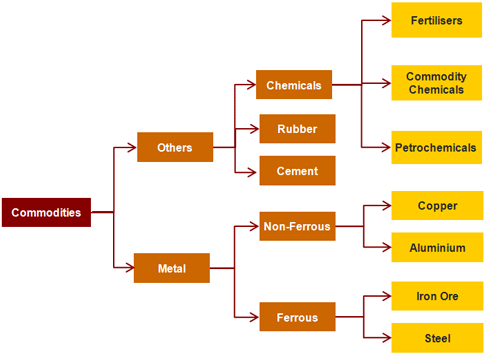
Image by DevangshuNandi1540630. Used under Creative Commons Attribution-Share Alike 4.0 International license.

The intrinsic value, or melt value, of a coin is determined by the ratio of silver to base metals in its composition; this is the definition of purity. In Spice and Wolf, the silver trenni's face value, or its denomination, should not change due to a new minting. If the purity of silver in newly minted coins increases, this might translate to increased desirability because a currency with more silver is a mark of a powerful nation with rare assets. The face value of a U.S. penny, for example, is always one cent, but there are prohibitions on the exportation, melting, or alteration of pennies because of the need to keep them in circulation, as well as consideration of the melt value of its copper and zinc. Such prohibitions are also the case for currency like the trenni in Spice and Wolf.

The reason for increasing the silver content in a trenni coin, according to Spice and Wolf, is to manipulate this desirability and increase the coin's circulation compared with coinage from other nations. As Lawrence explains in the light novel I bought to supplement my viewing of the anime: 

"Nations do not always fight through strength of arms. If your country's currency is overwhelmed by a foreign coin, you've been just as thoroughly conquered. All the foreign king needs to do is cut off your supply of money, and your marketplace will die. Without money, you can neither buy nor sell. They control your economy." 

It seems several nations in the real world use multiple currencies. In the case of Ecuador and Zimbabwe, this is because their native currencies suffered from inflation, or the devaluing of a currency because of its abundance, which then causes an increase in the price of goods as businesses struggle to make more profit using the weaker currency. As a result, Ecuador and Zimbabwe rely on USD to stabilize their economies but cannot print USD on their own. To pay for USD they're using, these countries enter trade agreements with the United States for items like bananas or other commodities. 

In Spice and Wolf, Trenni would be able to command the local money supply if more people use its native currency; this is possible if its currency is more desirable in the local market due to a purity increase. Internationally, desirability is judged by frequency of trades on the exchanges, but I won't dare venture into those geopolitics. In both instances, anyone's interest in silver trenni is heavily based in how much the citizens trust Trenni's economy and political stability.

I'm gonna stop here, as this plot unravels into something far more complicated than I care to dive into. There are many, many Spice and Wolf Reddit posts and forums dedicated to explaining this first arc. The barrier to entry on this franchise is unusually high--and that's coming from someone who loves Ghost in the Shell: Stand Alone Complex. I hope you've learned a little about economics, though!

Friday, June 7, 2024

Frieren Would've Done the Same

Frieren: Beyond Journey's End is the best anime ever made according to many corners of the internet. It surpassed Fullmetal Alchemist: Brotherhood on MAL, has a 100% average on Rotten Tomatoes, 8.9 on IMDb, and has become a social media darling thanks to its eponymous, small-statured elf. After ending last season, the memes of Frieren, Fern, and Stark in modern day swag have kept the series alive until next season. Then, Ruixian Xu stopped a knife attack in Taiwan because Himmel "would've done the same," thrusting the franchise that never quite went away into the spotlight again. 

Frieren: Beyond Journey's End. Kanehito Yamada & Tsukasa Abe. Viz. 

Although our Taiwanese vigilante was obviously using a refrain Frieren makes throughout the series, it's notable that Himmel is dead by the time the story starts. For those who also read the manga, Himmel was both savior and folk hero during his time, making sure to do what little he could for everyone he met during the ten-year journey to fight the demon king. I just think it's odd for fandom to attribute acts of present-day heroism to someone who isn't canonically alive but lives on in the memories (and many, many monuments) scattered throughout the land. There's someone who is far more deserving of this hero-worship: Frieren herself.

Frieren: Beyond Journey's End. Kanehito Yamada & Tsukasa Abe. Viz. 

The quirk and charm of Frieren: Beyond Journey's End is that the story is rooted in saudade, the wistful memories that Himmel left Frieren with upon his passing. We almost never see Himmel as he lived but through Frieren's recollections. If we use Serie's statement about remembering each one of her disciples throughout her centuries, then I'd also assume Frieren, as an elf, has perfect memory recall. The flashbacks we see of Himmel are valuable as meeting him in real-time. But that's cheating for us as an audience, isn't it?

Frieren: Beyond Journey's End. Kanehito Yamada & Tsukasa Abe. Viz. 

Imagine Frieren: Beyond Journey's End without the Himmel flashbacks. The characters would be the same, but the presentation would be more somber, focused on a widow who cares for the children of her best friends as they guide her to heaven. She would recall stories of her lover (a word she doesn't use because elves seem incapable of doing so) and how she became a better person because of him. Instead of flashbacks, we'd watch Frieren's attention shift to a past that was, in elf time, only moments earlier. Her emotionless features may twinge with warm joy and piercing sorrow--until remembering the purpose of her journey. I think that Frieren, the same Frieren who gives herself to anyone in need because of a man we never had the privilege to know, would be someone worthy of our praise. 

Frieren: Beyond Journey's End. Kanehito Yamada & Tsukasa Abe. Viz. 

Next time you do a good deed, tell people that "Frieren would've done the same." Thanks for coming to my TED talk. 

Monday, June 3, 2024

Call of the Night and the Modern Manga Love Story

I'm a sucker for a good boy-meets-world kind of story. These tales feature teenagers who often bump into girls with entirely different backgrounds and far more experience navigating society. FLCL, Eureka Seven, and Gurren Lagann are ones that stand out in my mind; the otaku universe has a billion more tales just like them. Call of the Night is in the same vein, but with some contemporary twists I really dig. 

Here's the short version: Ko Yamori loves playing hooky and travels around the city from dusk til dawn. Before long, he bumps into Nazuna Nanakusa, who claims to be a vampire. (I'm ninety-nine percent sure Nazuna Nanakusa is based on Haruhara Haruko from FLCL). Ko, the weird and misanthropic kid he is, wants to become a vampire, too. Turns out the only way to make more vamps in this world is for the human victim to fall in love with their vampire. Naturally, Ko and Nazuna spend their time getting into antics while figuring out what love looks like for them.

Call of the Night, Vol. 1. Kotoyama, Viz Media.

Nazuna loves to drink and play video games. She makes a living by relieving people of their loneliness--giving massages, cuddling, and overall being a kind host. (Although it's tempting to consider this non-sexual business a uniquely Japanese idea, I feel this is more a symptom of isolation stemming within first-world, heavily capitalist and networked societies.) The glancing media critic might identify Nazuna as a manifestation of the Manic Pixie Dream Girl, but Call of the Night front loads almost half the series with an exploration of Nazuna's past and how she fits in (and doesn't fit in) with the rest of the vampire underworld. 

Call of the Night, Vol. 1. Kotoyama, Viz Media.

This uniqueness of character obviously brings her to Ko's attention in the first place. It also shows us the very-real phenomenon of worshipping people we just met before spending any real time together. Does learning more about Nazuna make her more or less appealing to Ko? The problem with IRL romance is that we often fail to appreciate people as relationships grow. Combined with the miserable contemporary dating scene and declining birth rates in the largest economies, any story about successful romance seems like a bold, defiant leap towards hopeful futures. Ko's desire to turn vampire comes from a naive but very human impulse to spend an exciting night with a good person.    

The thing about Ko is that he doesn't actually know what it's like to love. He's only a middle schooler, so that's totally valid, but Call of the Night lingers on this for long enough that I wonder if this is a teenage affect or a literal, chemical deficiency of oxytocin. It's clear that Ko isn't asexual and that he wants to understand the positive relationships some vampires share with humans. But this libido question is tied into the way vampires reproduce: sucking blood is inherently sexual, and converting someone into a vampire requires a love connection. To extrapolate again into real-world context, it's significant to note that teenagers report having less sexual intercourse, but this complicated by evolving definitions of what sexual intimacy and identity look like. In Call of the Night, the vampiric relationship is entirely dependent on consummation via bloodsucking and conversion, which causes trouble for Ko and Nazuna among the old guard when they fail to do so.

Call of the Night, Vol. 1. Kotoyama, Viz Media.

This post is titled Call of the Night and the Modern Manga Love Story, but discusses a manga centered around a heterosexual relationship. The manga does explore a few LGBT+ relationships, and these turn out to be significant in Nazuna’s life. Considering the value of sexual reproduction is nearly nonexistent for vampires, this gender indifference makes perfect sense for author Kotoyama to explore. Call of the Night is not a BL or yaoi manga; nevertheless, this attitude towards fluidity is refreshing. It's notable that this manga is part of the Viz Manga app and not the Shonen Jump one, so its target demographic feels broader than just action-loving boys.

Call of the Night, Vol. 1. Kotoyama, Viz Media.

At the risk of making a longer post with more ramblings about the contemporary state of love--a matter in which I am not an expert but can only speak from the perspective of someone married for six years--you should read Call of the Night. I plan on watching the anime as soon as I finish the manga.